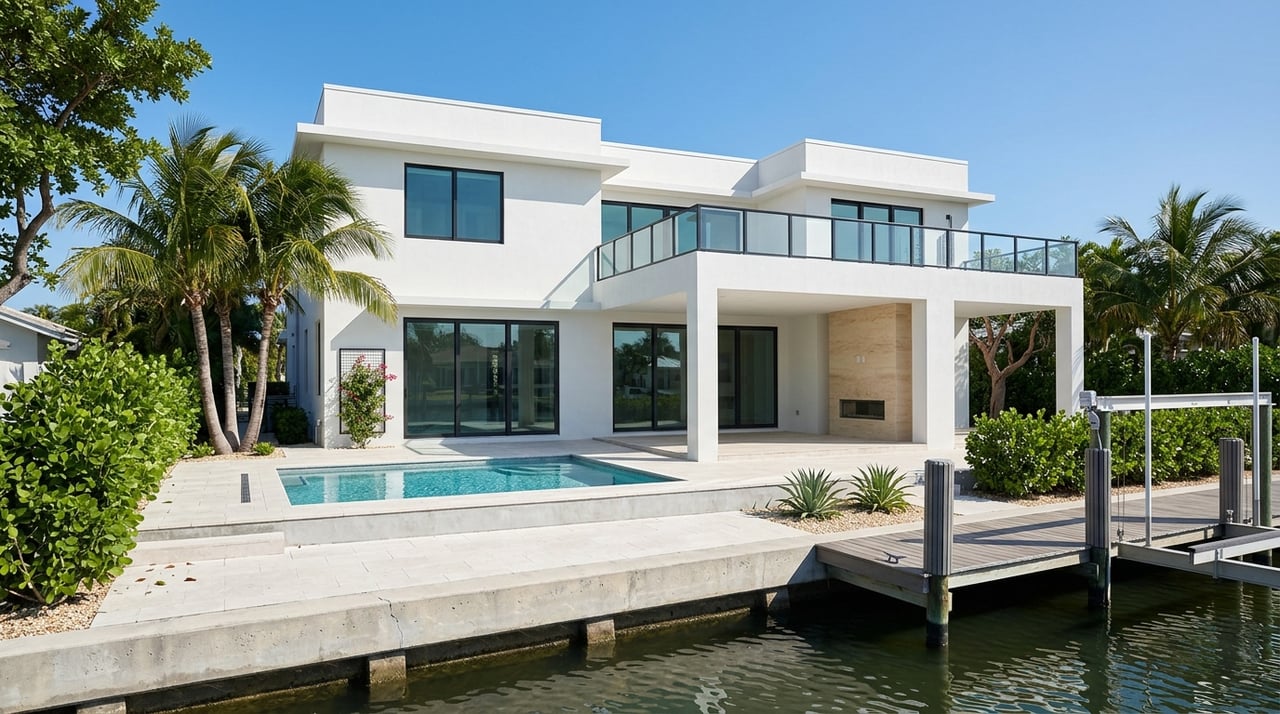
A Smart Guide to Florida Keys Luxury Second Homes
June 4, 2026
June 4, 2026
Thinking about a luxury second home in the Florida Keys? The right purchase here is about far more than price per square foot. If you want a property that fits your boating lifestyle, carrying-cost expectations, and long-term goals, you need to compare each island through a much more practical lens. Let’s dive in.
The Florida Keys do not behave like a single, uniform luxury market. Monroe County includes five municipalities: Key West, Marathon, Key Colony Beach, Layton, and Islamorada, and growth is shaped by the county’s ROGO/NROGO system, which is tied to a 24-hour hurricane evacuation model.
For you as a buyer, that means existing waterfront homes, buildable parcels, and properties with documented rental rights can carry outsized importance. In many cases, the details that matter most are legal use, boating setup, and storm logistics, not just finishes or headline asking price.
Monroe County tax data also shows how central second homes are to the local market. On the 2025 tax roll, non-homesteaded residential property represented 59.80% of taxable value, with an average taxable value of $1,049,046, while homesteaded residential property represented 19.41%. In plain terms, second homes are not a side story in the Keys. They are a core part of the market.
Recent Florida Keys luxury market reporting based on MLS data for homes listed at $1.8 million and above suggests a more balanced environment than the fast-moving pandemic years. Sales were fairly level over the prior 12 months, and inventory had returned to roughly pre-pandemic stable levels by March 2025.
At the same time, buyers appear to have more room to evaluate choices carefully. Days to contract rose from 97 to 114, and the spread between original list price and sale price widened to just over 14%.
Submarket performance has also varied. The same report noted a 32% increase in new luxury listings in Key Largo, while luxury sales were up 9% in Key West and 5% in the Upper Keys, but down 23% in the Middle Keys and 22% in the Lower Keys during the January through September 2025 comparison period.
For you, that points to an important takeaway: the Keys should be approached as a chain of distinct micro-markets. A strong strategy starts with choosing the right island pattern first, then narrowing to property type and waterfront fit.
If you are based in Miami and want a practical weekend escape, the Upper Keys usually enter the conversation first. County planning materials place the Upper Keys roughly from Mile Marker 110 to 90.5, with Key Largo in that corridor.
This area often appeals to buyers who want shorter travel times from the mainland, boating access, and large waterfront opportunities. Public listing examples in the area highlight what many luxury second-home shoppers compare here: open-water estates, bayfront lots, substantial dockage, and direct ocean access.
In other words, Key Largo is often less about a single neighborhood identity and more about the specific waterfront utility of each property. Dock length, channel depth, lift capacity, and approach to open water can matter more than two homes being close in price.
Islamorada spans about Mile Marker 90 to 72.6 across five inhabited islands. The village describes itself as a tourism-oriented, upscale small-town community known for boating and fishing, and it notes that growth is limited under its Area of Critical State Concern status while maintaining a 24-hour evacuation rule.
For many second-home buyers, Islamorada sits in a sweet spot between exclusivity and access. The housing stock often includes estate-style waterfront properties, and public listings emphasize shoreline frontage, private dockage, and boat-lift capacity.
If your goal is a refined waterfront retreat with strong boating identity, Islamorada often deserves close attention. The tradeoff is that limited growth and tighter supply can make legal use, property condition, and lot characteristics especially important.
Marathon sits between Mile Markers 47 and 60 and calls itself the Heart of the Florida Keys. It also benefits from Florida Keys Marathon International Airport, which Monroe County owns and operates, with general aviation and international arrival service.
That can make Marathon especially practical if you want a centrally located base for seasonal use. You get easier reach to multiple parts of the island chain, plus a broad range of luxury and near-luxury waterfront product.
Public listings in Marathon show this variety clearly, from dual-waterfront estates with long docks and multiple lifts to larger waterfront parcels with private beach features. If you want a central location and wider property-type range, Marathon may offer a compelling mix of utility and flexibility.
The Lower Keys, including areas such as Big Pine Key, Sugarloaf, and Shark Key, often feel different from the more resort-oriented parts of the chain. Monroe County places Big Pine Key around Mile Marker 33 to 29.5 and describes it as the gateway to the Lower Keys.
In practice, this part of the market often attracts buyers focused on privacy, larger water-frontage parcels, and a less dense setting. Public listings in these areas point to private waterfront estates, dock and lift access, and more room to prioritize seclusion.
If your ideal second home is quiet, waterfront, and less tied to a concentrated village or tourism hub, the Lower Keys can be worth serious consideration. Here again, boating details and legal use matter more than broad labels.
Key West is the southern terminus of the chain and has the most urban, historic, and regulation-sensitive feel. It offers a very different experience from the rest of the Keys, blending walkability, historic housing stock, marina-related assets, and stricter parcel-by-parcel review for rental use.
The city allows transient rentals only in specific zoning districts and publishes a transient-rental map and address list. That means if you are hoping to offset carrying costs with short-term income, you should treat zoning verification as an early due-diligence item, not a final checkbox.
For some buyers, Key West is the right fit because it offers a distinct lifestyle and a broader mix of property types, including historic homes and marina-oriented ownership. For others, the regulatory layer may push them toward another submarket.
In the Florida Keys, waterfront does not automatically mean equal waterfront. A property can be visually stunning and still miss the mark if your vessel, draft, or access needs do not match the dock setup.
Monroe County notes that the entire Keys lies within the Florida Keys National Marine Sanctuary no-discharge zone. The county says there are more than 30 shoreside pump-out facilities plus a free mobile pump-out service, and vessels anchored or moored more than ten consecutive days must provide proof of pump-out.
That makes boating logistics part of the ownership equation. If you plan to keep a boat at your property, you should compare:
Monroe County also has eight public boat ramps, including access points in Key Largo, Tavernier, Big Pine Key, Little Torch Key, Cudjoe Key, Geiger Key, and Big Coppitt Key. Even if you plan to buy a fully equipped waterfront home, the broader boating infrastructure still matters when you compare convenience across submarkets.
One of the costliest mistakes in the Keys is assuming a home can be used as a vacation rental without verifying the rules. Rental regulations vary sharply by jurisdiction.
In unincorporated Monroe County, special vacation rentals under 28 days are allowed only in certain land-use districts, and all advertising must show a 28-day minimum. Marathon requires a vacation-rental license and says rentals must be between 7 and 28 nights. Islamorada states that vacation rentals may occur only at licensed properties, and Key West allows transient rentals only in specific zoning districts.
If rental income matters to your plan, confirm zoning and licensing before you underwrite the deal. In the Keys, documented rental rights can materially affect value and buyer demand.
Flood and evacuation planning should be part of your first-pass screening, not something you review after inspections. Monroe County warns about the Keys’ low elevations and uses a phased evacuation plan with zones 1 through 5, while Islamorada separately highlights its 24-hour evacuation rule.
When two homes seem comparable on paper, differences in flood zone, elevation, and evacuation zone can shape both peace of mind and long-term carrying costs. These factors should be weighed alongside lifestyle features, not after them.
Taxes work differently when the property is not your primary residence. Monroe County Property Appraiser guidance says the homestead exemption applies to a primary residence, can reduce assessed value by up to $50,000, and establishes the Save Our Homes cap.
The same office says the non-homestead cap limits annual assessment increases to 10%. For you as a second-home buyer, that means your tax picture is driven by assessed value and exemption status, not simply the purchase price.
Insurance remains a major budget item in the Keys. A recent luxury market report identified rising Florida insurance premiums as a factor affecting buyer enthusiasm, even as Florida’s insurance office announced Citizens Property Insurance rate reductions starting in spring 2026.
That is encouraging, but conservative budgeting still matters. When you evaluate a second home here, underwrite for wind, flood, and hurricane-related carrying costs from day one.
Buyers often ask whether flood zone, evacuation zone, dock depth, or rental zoning should come first. The honest answer is that your intended use should set the order.
If you want personal enjoyment with serious boating, dock geometry, depth, and access may be the lead filters. If you want income flexibility, rental zoning and licensing may need to come first. If you are trying to control long-term risk and carrying costs, flood exposure, evacuation logistics, tax treatment, and insurance may deserve top billing.
The key is not to compare properties with a generic luxury checklist. In the Florida Keys, the smartest comparison framework is use-based, island-specific, and detail-driven.
That is where experienced guidance can create real value. When you are weighing waterfront utility, legal rental use, tax treatment, insurance planning, and financing structure at the same time, having brokerage and lending insight under one roof can help you move with more clarity and less friction. If you are considering a Florida Keys second home and want a discreet, strategic approach, connect with Miami Brokers Group.
Stay up to date on the latest real estate trends.
Etiam non quam lacus suspendisse faucibus interdum. Orci ac auctor augue mauris augue neque. Bibendum at varius vel pharetra. Viverra orci sagittis eu volutpat.