Seawall Due Diligence in Gables by the Sea: Permits, Costs and Listing Details
October 1, 2026
October 1, 2026
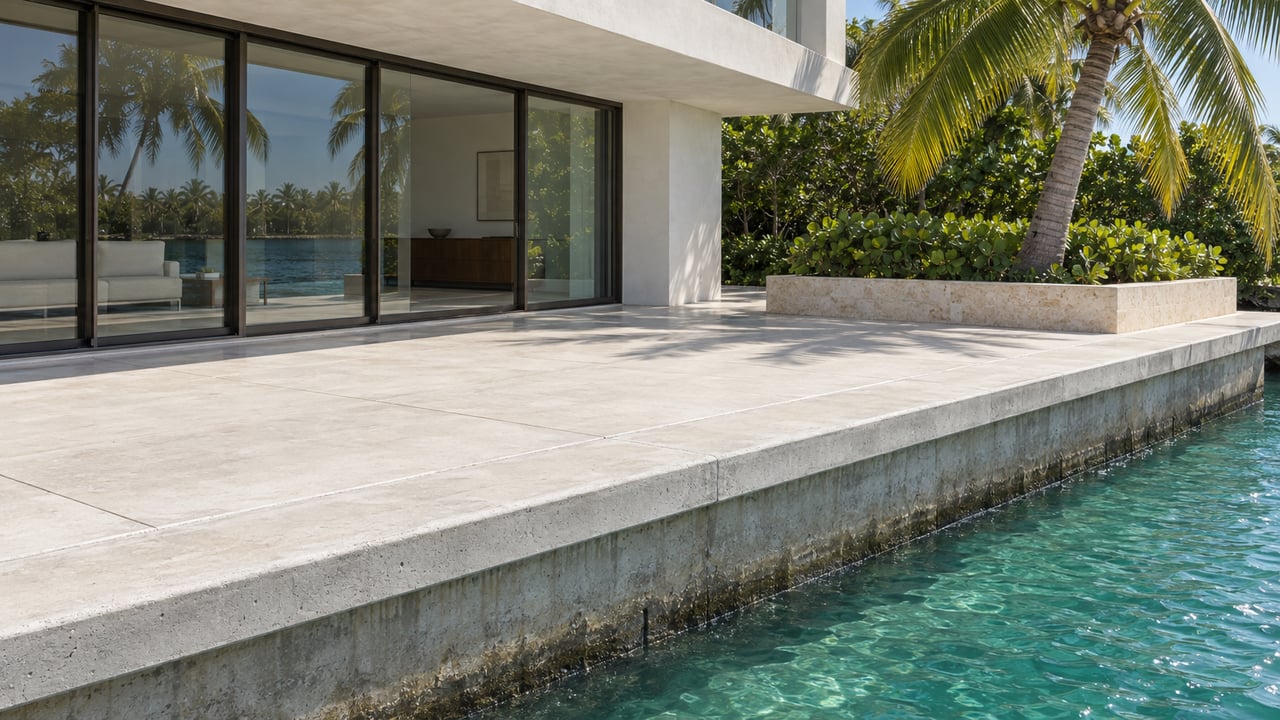
A buyer under contract on a canal-front house in Gables by the Sea gets the marine engineer's report back three weeks before closing. The tiebacks behind forty feet of the seawall are failing. Soil is migrating out through hairline cracks below the waterline, the kind of damage that looks cosmetic from the pool deck and isn't. Two years ago, that finding turned into a stall. Nobody could put a number on the fix, because nobody could say how long Miami-Dade would take to approve it. Permits for seawall work in the county had been running eighteen to twenty-four months, long enough that a buyer walked or a seller cut the price on a guess rather than a fact.
The reform was approved on July 1, 2025. By early 2026, new seawall submissions in Gables by the Sea were moving under a different clock.
On July 1, 2025, the Miami-Dade Board of County Commissioners voted unanimously to approve a seawall permitting reform introduced by Commissioner Eileen Higgins. The county had fallen well behind its neighbors. Broward and Palm Beach counties were routinely clearing similar permits in three to six months. Miami-Dade's own review process, by contrast, had stretched to eighteen to twenty-four months, an unpredictability that landed squarely on anyone trying to close a waterfront sale with an open seawall question.
The centerpiece of the reform is a tracking system the county calls Gold Key, which the Department of Environmental Resources Management introduced to applicants and professionals through a public webinar on December 1, 2025. By early 2026 it was live for all new seawall submissions countywide, and it came with review windows that are now written into the process rather than left to staff discretion. According to Breezy Permits, a Completeness Summary has to go out within ten days of an application landing. The county can only come back asking for more information three times. Once that Completeness Summary is issued, a final decision on a Class I seawall or bulkhead permit is due within ninety days. Permit modifications get thirty days.
Eight months of runway is enough to say this is a working system, not a press release. It has changed what a seawall problem actually is at the negotiating table. A risk that used to have no shape now has a floor and a ceiling.
Gables by the Sea is not a neighborhood where a seawall is optional infrastructure. The community is guard-gated with canal access to Biscayne Bay, and a meaningful share of its value comes from water without a fixed bridge in the way, meaning a real boat can get from a private dock to open water without waiting on a bridge tender. That kind of access is the reason listings routinely describe a hundred feet of frontage or a slip that holds a sixty-foot vessel as the headline feature, ahead of square footage or bedroom count.
Active listings in the neighborhood right now sit at a median of roughly $5.34 million across the waterfront homes on the market, a figure that moves with a handful of transactions given how small this inventory is. That median tells a buyer almost nothing about condition. It tells them nothing about the seawall specifically, and the seawall is the one structural element in this neighborhood that both defines the value and sits entirely outside the house itself.
New residential seawall construction in Florida typically runs $400 to $1,200 per linear foot depending on material, with concrete panel systems at the upper end of that range and vinyl or composite sheet pile cheaper to install. Barrier islands and dense coastal counties push those numbers higher still, with Miami-Dade projects commonly quoted at $1,500 to $2,500 per foot once labor, mobilization, and site access are factored in. A hundred-foot wall, the kind that shows up constantly in Gables by the Sea listings, can land anywhere from $150,000 to about $250,000 depending on which side of that range the property falls on.
The industry rule of thumb for deciding between repair and full replacement is straightforward: once repair costs climb past roughly 70 percent of what a new wall would cost, or the existing wall is already thirty to fifty years old, replacement becomes the more defensible spend. That threshold matters here because it turns a vague engineering finding into a specific financial decision a buyer and seller can actually negotiate around instead of arguing about in the abstract.
Coral Gables, which handles the building permit side of any renovation in Gables by the Sea, runs its own review in parallel with the county's environmental process. One recent waterfront renovation in the neighborhood, finished in January 2026, carried a full slate of Coral Gables permits alongside its structural work. The county's Gold Key reform speeds up DERM's side of that approval. It does not touch the city building department's own schedule, which means a seawall project here is still running on two clocks, even though one of them now moves faster and more predictably than it used to.
Miami-Dade reviews the construction, repair, or replacement of a seawall, and the applicable process depends on project scope. Dredging or fill can come into play when a buyer wants to deepen a slip for a larger vessel.
Walk through active listings in Gables by the Sea and the language repeats itself: a hundred-foot reconstructed seawall, a newly rebuilt seawall completed roughly three years ago, a brand new dock with underwater lighting. Marketed this way, these read as amenities, on par with a summer kitchen or a wine cellar.
They can be amenities, and they also leave a paper trail worth reviewing. A reconstructed seawall means someone already absorbed a six-figure capital project and, under the old permitting timeline, likely waited well over a year for approval to do it. A newly rebuilt wall from three years ago places the work squarely before the July 2025 reform, meaning that seller navigated the slower county process; a current buyer's timeline depends on the project's scope. Either way, the detail belongs in the diligence file, not just the marketing copy. A buyer should be asking for the permit history and the completion date on any seawall described this way, the same way they'd ask for a roof's age on a house with no water frontage at all.
Gables by the Sea's own governing structure adds a layer worth understanding here too. Gables Estates' dues run in the range of $7,500 a year for the association covering security and common areas. Gables by the Sea operates with an HOA fee.
There is no association reserve fund standing behind every seawall the way a condo association might carry one. That was true before the reform and remains true after it. What the reform actually changes is what happens once a problem surfaces. According to Team Renick, Florida's standard purchase contract already allows for a price credit or an escrow holdback when an issue turns up during due diligence, before closing. Neither of those tools works well against an unknown timeline. They work well against a specific number and a specific date, which is exactly what the Gold Key system now gives both sides of a Gables by the Sea transaction that didn't exist reliably before July 2025.
How does review vary by project scope? The level of review depends on the scope of the work.
Who actually pays when a seawall problem turns up during a sale? Nobody automatically. Florida's standard Realtors and Florida Bar contract allows for a price credit or an escrow holdback if the issue is found before closing, but either outcome gets negotiated between buyer and seller. What the county reform adds is a real number and a real date to anchor that negotiation around, instead of an open-ended guess about permitting.
Does the county's faster process also speed up city approval in Coral Gables? No. The Gold Key reform applies to Miami-Dade DERM's review under the Class I permit system. Work in Gables by the Sea also needs a separate building permit from Coral Gables' own Development Services department, which runs on its own schedule and isn't bound by the county's new timelines.
A seawall in Gables by the Sea is not a line item you can skip past on the way to the dock and the view. If you're weighing a purchase here, or wondering what a wall's condition and permit history actually mean for your price or your timeline, Miami Brokers Group can walk through the specific parcel with you and structure the financing around whatever that seawall turns out to need.
This article is general information, not legal, tax or financial advice. Consult a qualified professional about your situation.
Stay up to date on the latest real estate trends.
Etiam non quam lacus suspendisse faucibus interdum. Orci ac auctor augue mauris augue neque. Bibendum at varius vel pharetra. Viverra orci sagittis eu volutpat.