Ponce Davis Has No Water, No HOA, and No City Hall. That's Why Dry Lots Are Outpricing the Waterfront.
September 17, 2026
September 17, 2026
Ask a broker to find you a listing in Ponce Davis and you will likely get the same answer twice: there isn't one. So agents and prospective buyers do something you rarely see in a market this expensive. They knock on doors. Owners in the neighborhood are approached directly and asked, informally, whether they would consider selling. Most of the time the answer is no.
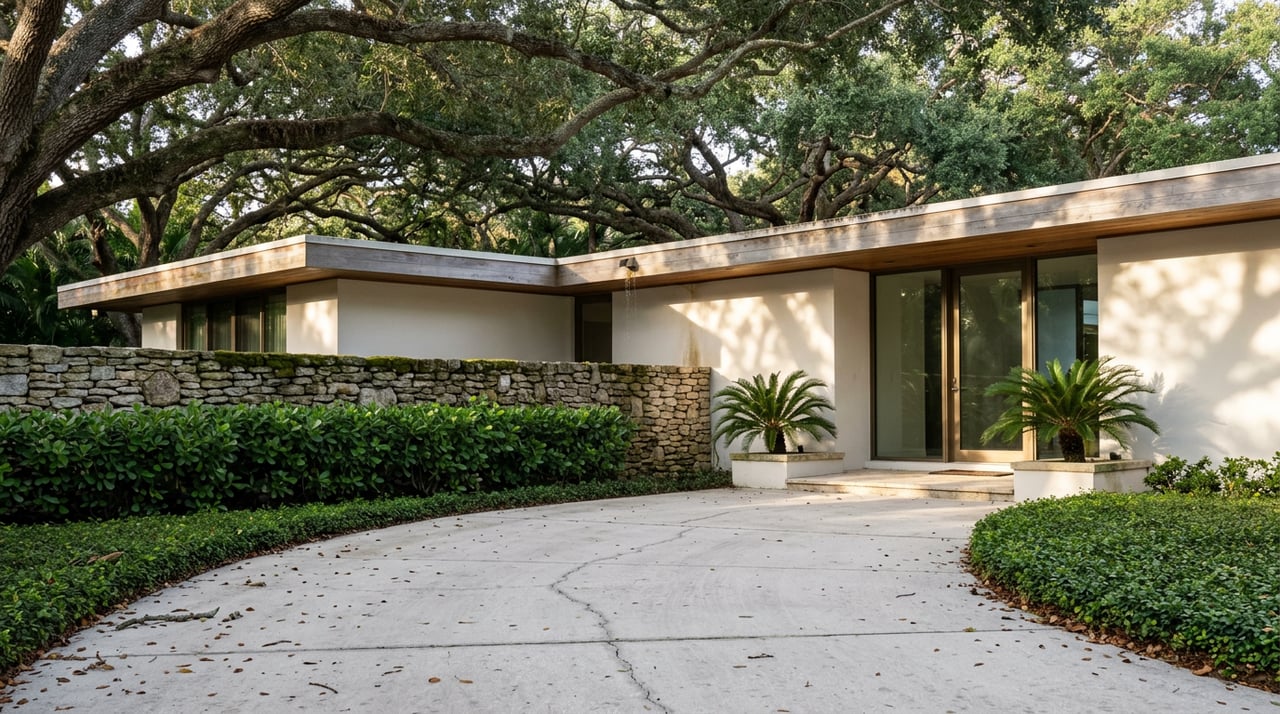
That single fact tells you more about this four-or-five-block pocket of unincorporated Miami-Dade than any comp sheet could. Ponce Davis sits between South Coral Gables and Pinecrest, has no waterfront, no homeowners association, and no city government of its own. By every rule of thumb that governs Miami real estate, it should trade at a discount to the waterfront enclaves that surround it. Instead, this past April a brand-new one-acre estate at 5545 SW 81st Terrace, built by SL5 Developments, listed for $22 million. In the twelve months leading into a mid-2026 brokerage report on the neighborhood, ten homes sold above $10 million and four sold above $15 million, all of them, in the report's own words, "purely dry lot homes."
That is the thesis worth sitting with if you are comparing Miami micro-markets: Ponce Davis proves that in this city, water is not the only thing buyers pay a scarcity premium for. Control is.
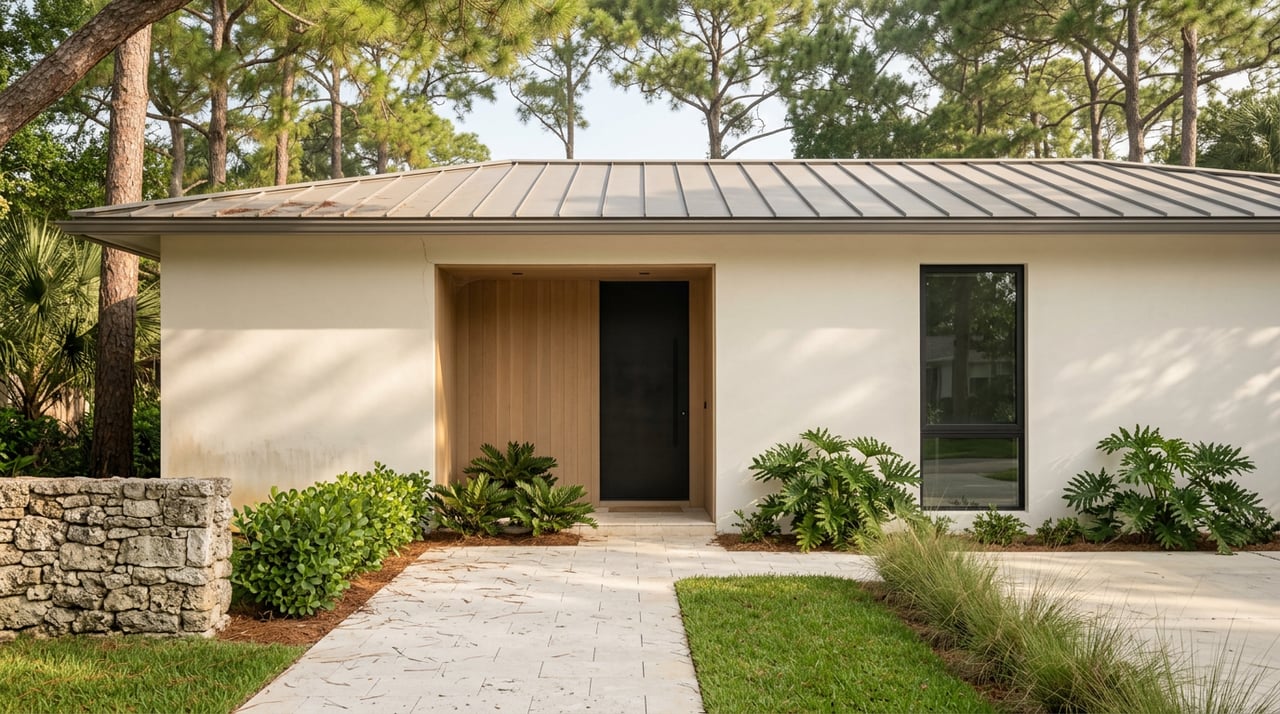
Conventional Miami logic says price follows the shoreline. Old Cutler Bay and Gables Estates command their numbers because a boat can leave the dock and reach the bay without a bridge in the way. Ponce Davis has none of that. The 5545 SW 81st Terrace listing, a seven-bedroom, roughly 10,000-square-foot house, is described by its own listing agent as one of only two full-acre new-construction homes in the entire neighborhood, and the only one currently move-in ready. There is no dock to photograph. There is no water view to sell.
What the listing agent, David Siddons of Douglas Elliman, points to instead is the land itself. "It's an irreplaceable piece of geography," he told a real estate outlet covering the listing back in April. That is not marketing language dressing up a weak position. In a county where a full acre inside the urban core rarely comes up for sale at any price, the acre is the amenity. Water access would be additive. Here it is beside the point.
Strip away the price tag and Ponce Davis is selling a specific bundle that is hard to assemble anywhere else in Miami-Dade: mature tree canopy, homes set back behind landscaping rather than facing the street, minimal through traffic because the interior streets do not connect anywhere useful, and access to some of the strongest public magnet programs in the county. Sunset Elementary's International Magnet program, Ponce de Leon Middle's Magnet and IB track, and Coral Gables Senior High's Magnet and IB program all draw from the neighborhood, alongside private options including Epiphany Catholic School, St. Thomas Episcopal Parish School, Our Lady of Lourdes Academy, and Gulliver Prep.
None of that requires water. All of it requires land, and land inside this particular box has stopped changing hands with any regularity.
Here is how that bundle compares to the waterfront alternative most buyers consider first:
| Ponce Davis | Gables Estates / Old Cutler Bay | |
|---|---|---|
| Governing body | Unincorporated Miami-Dade County | Incorporated municipality |
| HOA | None | Yes, with architectural review |
| Water access | None | Direct bay or canal access |
| Entry control | No single gate; some sub-enclaves gated | Guard-gated community entrance |
| What sets the price | Land scarcity, privacy, schools | Waterfront frontage, dock access |
The two markets are not competing for the same dollar. A buyer choosing Ponce Davis over the waterfront is not settling for less. They are choosing a different asset entirely, one where the absence of a homeowners association means no architectural review board and no shared covenants dictating what gets built, and the absence of a city hall means the neighborhood has never been rezoned or redesigned to accommodate anyone's growth plan.
That last point matters more than it sounds like it should. Because Ponce Davis is unincorporated, permitting and land-use decisions run through Miami-Dade County's zoning department rather than a dedicated city building official who knows the block. The county's own RU-1 zoning code sets the baseline setback and height rules that apply here the same way they apply across other unincorporated single-family districts, without a local municipal layer adding its own design review on top.
For a buyer planning a renovation or new build, that cuts both ways. There is more architectural latitude than in a covenant-restricted subdivision. There is also less of a dedicated point of contact walking a project through approvals, which is precisely the kind of friction that surfaces only once a contract is signed and a construction timeline is on the line. Anyone underwriting a teardown or ground-up build here should treat the jurisdictional path as part of the deal structure from day one, not an afterthought once design is finalized.
The door-knocking habit is not folklore. It is what a market does when turnover approaches zero. Census data puts the neighborhood at roughly 443 households and 1,477 residents, a population small enough that a handful of sales in a given year can swing the entire trailing-twelve-month comp set.
Even the boundaries reflect how rarely anyone needs to define them precisely. One description draws Ponce Davis between Kendall Drive to the north, Sunset Drive to the south, Old Cutler Road to the east, and Red Road to the west. Another, tighter version runs from Schoolhouse Road and Erwin down to a band between SW 80th and SW 88th Streets. Both descriptions are pointing at the same handful of blocks. The disagreement is not sloppy research. It is a symptom of a market so thin that no single source has ever had reason to settle the question, because the properties inside those lines almost never come up for sale to force a definitive map.
The one thing that could move this market without a single new listing inside Ponce Davis itself is happening a short drive away. Demolition of the Shops at Sunset Place in downtown South Miami was slated to begin in the first quarter of 2026, clearing the way for a Heatherwick Studio-designed mixed-use district led by Midtown Development: seven towers ranging from 12 to 33 stories, 1,513 residences, a 287-room hotel, and a pedestrian street grid replacing the enclosed mall that has struggled for years. The first phase, streets and a condo-hotel, is expected by 2029.
Local brokers watching the project have compared its potential effect on the surrounding area to what CocoWalk's reimagining did for Coconut Grove: more foot traffic, more restaurant density, more reasons to stay in the immediate area rather than drive north. Ponce Davis will not gain a single new dwelling unit from any of this. Its zoning does not change, its lot sizes do not change, its lack of an HOA does not change. But a neighborhood whose entire appeal rests on being minutes from a walkable, well-programmed commercial core just watched that core get a multi-year, publicly approved rebuild a few blocks from its edge.
Is Ponce Davis a gated community? Not as a whole. Most homes sit behind mature landscaping and private setbacks rather than a single controlled entrance, though at least one guard-gated sub-enclave, Stonegate, exists within the broader area for buyers who want a controlled entry point specifically.
Does Ponce Davis have a homeowners association? No. There is no neighborhood-wide HOA governing architecture or landscaping, which gives owners more design latitude than a covenant-restricted community, with the tradeoff of no shared enforcement mechanism if a neighbor's project changes the character of the block.
How do you actually buy a home here if nothing is listed? Relationships do the work that a search portal cannot. Because so few owners list publicly, access tends to run through brokers who already know which households might consider a private conversation, which is a different skill set than searching an active inventory feed.
Ponce Davis is not a neighborhood you shop. It is one you position yourself to hear about before anyone else does, and one where financing a ground-up build or an off-market purchase requires a team that can move as quietly as the sellers do. If you are weighing a dry lot here against a waterfront alternative elsewhere in Miami-Dade, Miami Brokers Group can walk through what each actually buys, and what it costs to build or finance on either side of that decision. Request a private valuation and consultation to start that conversation.
Stay up to date on the latest real estate trends.
Etiam non quam lacus suspendisse faucibus interdum. Orci ac auctor augue mauris augue neque. Bibendum at varius vel pharetra. Viverra orci sagittis eu volutpat.