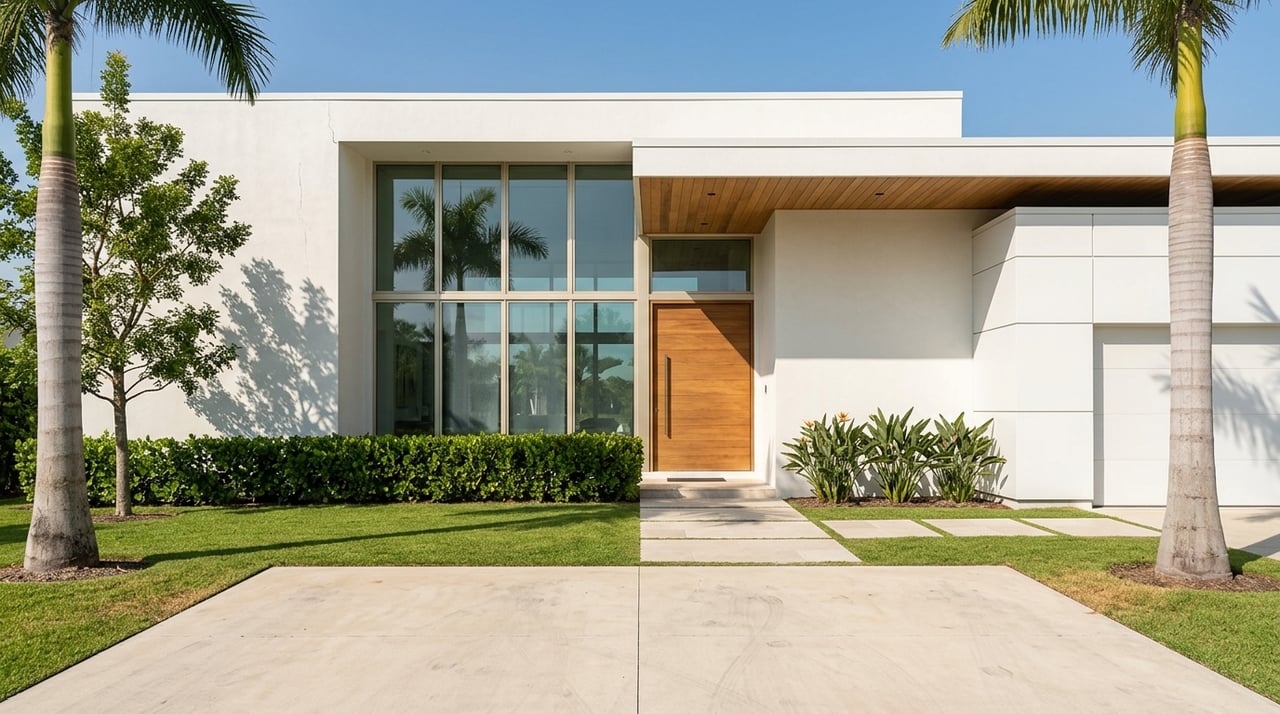
Should You Renovate or Rebuild in Gables Estates?
June 11, 2026
June 11, 2026
If you own in Gables Estates, “renovate or rebuild?” is not a simple design question. In this waterfront enclave, the lot, shoreline, dock setup, and buildable envelope can carry as much value as the house itself. The right path depends on how your property fits Coral Gables rules, flood requirements, and current buyer demand. Let’s dive in.
In Gables Estates, buyers are not only paying for finished homes. They are also paying significant premiums for waterfront land and redevelopment potential. Recent reported sales included 41 Arvida Parkway at $50 million, 340 Leucadendra Drive at $55 million, a 1.38-acre waterfront lot at 10 Casuarina Concourse at $27 million, and 9175 Arvida Parkway at $14.9 million with plans for a new mansion.
That pattern matters if you are weighing a major renovation. In many neighborhoods, improving the existing house is the default move. In Gables Estates, a home that is poorly sited, hard to expand, or expensive to bring into compliance may be more valuable as a rebuild opportunity.
A common mistake is focusing first on finishes, layout, or square footage. In Gables Estates, the better first question is how the parcel performs. Waterfront frontage, shoreline geometry, view orientation, and marine access can strongly shape what buyers will pay.
Recent listing coverage of a Gables Estates property on a V-shaped lot with direct waterfront views and a private dock highlights this point. Features like lot shape and dock utility are not minor details here. They are part of the core value proposition.
If your house sits awkwardly on the lot, limits view corridors, or leaves little flexibility for expansion, that can tilt the analysis toward rebuilding. If the home already takes good advantage of the site and water access, renovation may be a more efficient path.
Before you price a renovation or market a property as a teardown, you need to understand the city’s site-specific rules. Gables Estates does not operate under one simple, uniform envelope. What you can add, move, or rebuild depends on the exact section and plat conditions affecting the property.
Coral Gables regulations for Gables Estates limit residences in the coastal flood hazard district to 2.5 stories and 42 feet above established grade. The additional height from 39 to 42 feet is limited to properties with at least a 30-foot side setback, with some lots exempt.
Separate Gables Estates No. 3 provisions set 50-foot front setbacks, 30-foot side setbacks, and a 50-foot setback from the canal, waterway, or bay shoreline. Those standards can materially affect whether a large addition is realistic or whether a fresh design would make better use of the allowed envelope.
If you are considering major work, assumptions can get expensive fast. Coral Gables’ Board of Architects application requires a current survey no older than five years, color photographs, and a contextual neighborhood study for a change in style or large additions.
For substantial renovations or new homes involving demolition of the existing structure, the city also requires a historical significance determination letter. The application materials also flag HOA approval for Gables Estates, Gables Estates 2, and CocoPlum 2 associated areas. In practice, that means your project timeline and strategy need to be built around review requirements from the start.
One of the biggest issues in waterfront renovation planning is the substantial-improvement threshold. Coral Gables states that elevation certificates are required for all new construction and substantial improvements. The city’s flood guidance uses the 50% rule, meaning if repair or improvement costs equal or exceed 50% of the structure’s pre-improvement market value, the work can trigger new-construction flood requirements.
That threshold can change the economics of a project. A renovation that looks manageable at first can become much more complex once structural work, elevation-related work, foundation work, and code-triggered upgrades are included.
Coral Gables’ FEMA cost worksheet makes an important distinction. Costs tied directly to the building count toward the calculation, while landscaping, pools, detached accessory structures, driveways, and similar outside improvements are excluded.
That means an owner cannot judge the threshold by visible finishes alone. A luxury kitchen and bath remodel may not tell the whole story if structural changes, additions, or flood-related corrections are also part of the scope.
In Gables Estates, the house is only part of the project. Seawalls, bulkheads, docks, davits, lifts, and foundations can drive cost and complexity in a major way. If those elements need significant intervention, a rebuild may become the cleaner solution.
Coral Gables guidance states that bulkheads, retaining walls, and similar waterfront installations must be built of reinforced concrete, prestressed concrete, or gravity mass non-reinforced concrete. Plans must also be signed and sealed by a professional engineer.
The city has also stated that Gables Estates may allow two sets of davits, but the second set is only permitted on properties with 100 feet or more of waterfront. City guidance further notes that floating watercraft lifts and similar structures, including floating docks, may be allowed when properly authorized and reviewed for zoning, construction, and design compliance.
Foundation requirements can also reshape the decision. Coral Gables public works corrections note that, for projects east of Old Cutler Road within the shaded foundation-map area, structures generally must be supported on pile foundations unless a rock-formation exception applies.
That is not a minor technical detail. If your renovation path starts to involve major structural intervention and foundation work, the cost difference between saving the existing house and building new may narrow quickly.
If you are leaning toward a teardown, you still need to plan for review. Coral Gables Ordinance No. 2023-03 states that demolition permits for non-designated buildings and structures must be approved by the Historic Preservation Officer or designee.
That approval is valid for 18 months, and citizens may appeal within 10 days of online posting. In other words, demolition is not simply a private construction decision. It is part of a public process with timing implications.
The market in Gables Estates is rewarding both ends of the spectrum. Buyers are paying top dollar for exceptional finished estates, but they are also buying properties for the land and redevelopment potential.
Reported activity includes record-setting transactions at $50 million and $55 million, plus sales of waterfront properties where a new build was expected. A 1-acre waterfront property at 665 Leucadendra Drive reportedly traded for $24.3 million with expectations of a teardown, while 9175 Arvida Parkway sold for $14.9 million with plans for a new mansion.
For sellers, that creates an important opportunity. You do not have to force one narrative if the property supports another. Sometimes the highest-value strategy is to market a home as a polished luxury residence. Other times, the better strategy is to position it as a prime parcel with redevelopment upside.
If you are deciding whether to renovate before selling, sell as-is, or rebuild, focus on the variables that most affect outcome in Gables Estates:
When the existing residence already sits well on the parcel and the work can stay inside the city’s envelope and flood rules, a thoughtful renovation or measured addition can make sense. When the structure is poorly positioned, the waterfront edge needs major reconstruction, or the total scope is nearing substantial-improvement territory, a rebuild or land-focused sale strategy may be more rational.
In a market like Gables Estates, presentation without strategy can leave money on the table. Buyers in this segment often look beyond cosmetic condition. They study entitlement potential, marine usability, lot orientation, and the likely cost of getting from today’s structure to tomorrow’s ideal estate.
That is why pricing, pre-listing analysis, and deal structure matter so much. A seller may benefit from understanding not only what the home is worth today, but also how developers, end users, and private buyers may each underwrite the same property differently.
For high-value properties with renovation, redevelopment, or financing complexity, having brokerage and lending insight in one conversation can help you assess the full picture more clearly. In a neighborhood where every site tells a different story, precision matters.
If you want a discreet, data-driven read on whether your Gables Estates property is best positioned for renovation, rebuild, or sale as a premium lot, Miami Brokers Group can help you evaluate the options with a private valuation and consultation.
Stay up to date on the latest real estate trends.
Etiam non quam lacus suspendisse faucibus interdum. Orci ac auctor augue mauris augue neque. Bibendum at varius vel pharetra. Viverra orci sagittis eu volutpat.