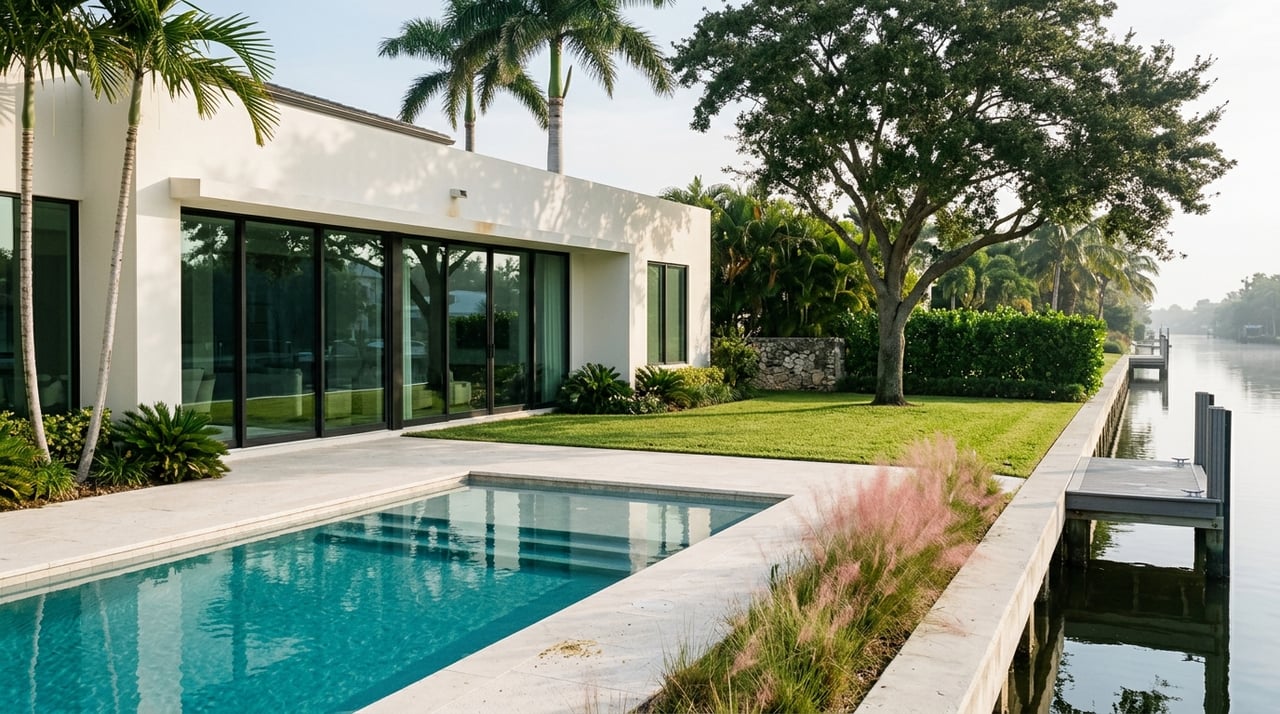
Understanding Gables Estates Club Membership for Buyers
August 27, 2026
August 27, 2026
A buyer who wires full proceeds, waives every contingency, and signs at asking price has not bought a house in Gables Estates. Not yet. Before a deed can transfer inside this Coral Gables enclave, that buyer still needs two sponsors already living in the community, banking references, letters of recommendation, a background check, and formal approval from a private homeowners' board that can say no. The purchase agreement is the easy part. The Gables Estates Club is the part that actually decides who moves in.
This matters because most of what gets written about Gables Estates treats the price tag as the whole story. Zillow's Home Value Index for the twelve months through July 2025 put the neighborhood's typical home value at roughly $21 million, enough to knock Beverly Hills out of the top spot nationally and make Gables Estates one of seven Florida neighborhoods in the country's ten most expensive. That number gets repeated everywhere. What gets repeated far less is what actually determines whether a signed contract becomes a closed sale, and why the neighborhood's own sales data barely agrees with itself from one quarter to the next.
Every buyer in Gables Estates has to become a member of the Gables Estates Club, Inc., the homeowners association that governs the 179 lots the developer Arthur Vining Davis laid out along Biscayne Bay in the early 1960s. Membership is not a formality that happens automatically at closing. It is a separate approval process that runs alongside, and can outlast, the real estate transaction itself.
The application asks for:
None of that is refundable if the board says no. And the fee sits on top of the purchase price, not inside it. A buyer closing on a $28 million estate is also writing a six-figure check to a private club with no guarantee of return if the application stalls.
Ask three real estate sites what a home in Gables Estates actually costs and you'll get three different answers, and the gap isn't noise. It's a symptom of how few transactions this market actually produces in a given stretch of time.
| Source | Metric | Figure | Window |
|---|---|---|---|
| Portal-reported trailing 12-month median sale price | Closed sales | $12.325 million | 12 months ending May 2026 |
| Same portal's point-in-time median list price | Active listings | $15 million | May 2026 |
| Neighborhood page median sale price cited by a Miami luxury advisory firm | Closed sales | approximately $50 million, reported up roughly 170 percent year over year | November 2025 |
| Weekly Miami-Dade luxury contract report (Eklund-Gomes team, Douglas Elliman) | Average days on market, all Miami-Dade luxury listings $4M+ | 119 days | week of May 25-31, 2026 |
Look at the top and third rows. Two data sources, both describing sales in the same small enclave, land six months apart at $12.3 million and roughly $50 million. That isn't a market correcting. It's a market with so few closings in any given window that one or two ultra-high sales can swing the median by a factor of four. A luxury advisory firm covering the neighborhood made the same point directly: in a thinly traded enclave, a handful of sales can move a median sharply, and buyers should treat dashboard figures as directional signals rather than a price for any specific property.
Time on market tells a similar story. One portal's neighborhood page puts average days on market at 141. A separate national portal's own listing page for Gables Estates waterfront inventory puts it at 319, more than double. Compare either number to the 119-day average across all Miami-Dade luxury listings priced above $4 million, tracked in a weekly report covering late May 2026, and Gables Estates properties are sitting on the market anywhere from slightly longer to nearly three times longer than the county's broader luxury segment. Financing contingencies and inspection periods don't explain a gap that wide on their own. Club review timelines do.
The $7,500 annual HOA dues fund a security operation that includes 24-hour armed guards, a monitored camera network with night vision, and water patrols by Coral Gables police alongside the club's own force. That infrastructure is real and it's part of what buyers are paying for. But the membership screening does something the guards and cameras can't: it controls who lives there in the first place, not just who can get past the gate.
For a buyer, that control has a practical cost measured in time and capital certainty. A deal that would close in 30 to 45 days almost anywhere else in Coral Gables has to be structured around an approval timeline that isn't fully within the buyer's control. Financing has to stay in place longer. Rate locks, bridge arrangements, and any seller concessions tied to a closing date all need to account for a review process that includes sponsor vetting and a board that meets on its own schedule, not the transaction's. Buyers moving capital across borders face the same math with less margin for error, since the $105,000 non-U.S. resident fee and the reference requirements apply regardless of how quickly funds can move.
This is the part of Gables Estates transactions that rarely makes it into a listing description, and it's exactly where a brokerage that also structures financing earns its fee. A pre-approved mortgage means little if the closing date depends on a club vote three months out.
Gables Estates has had 179 lots since Arthur Vining Davis platted the community more than sixty years ago, with an average lot size around 56,240 square feet. No new lots are coming. That's ordinary land scarcity, the kind that shows up in plenty of built-out waterfront neighborhoods. What makes Gables Estates behave differently is that the club layers a second, human scarcity on top of the physical one. Even if a lot changes hands, the buyer still has to clear a screening process that a seller in an open subdivision would never face.
Fernando de Nunez y Lugones, CEO of Vertical Developments, described the broader area to Fox News Digital as "naturally self-limiting since there's only so much prime land." In Gables Estates, that limitation runs through the club roster as much as the plat map.
The activity on the ground this year backs that up. A spec mansion at 340 Leucadendra Drive sold for $55 million in a deal that closed in mid-2025 and wasn't publicly reported until January 2026, a figure the Coral Gables Gazette described as the most expensive transaction ever recorded within the community, surpassing the $50 million paid by musician The Weeknd for a waterfront home at 41 Arvida Parkway. Months later, a renovated mansion at 33 Arvida Parkway sold for $55 million as well, tying that record after its owners had purchased it for $34 million just eight months earlier, according to reporting from The Real Deal. The same developer behind the Leucadendra Drive record turned around and paid $24.3 million for a different waterfront teardown on the same street, a deal reported in early May 2026, planning to demolish and rebuild. The month before, MasTec CEO and Inter Miami co-owner Jose Mas paid $14.9 million for a one-acre waterfront property on Arvida Parkway. As of early June 2026, a waterfront estate at 221 Casuarina Concourse was under contract asking $28 million, part of a weekly luxury contracts report that tracks signed deals across Miami-Dade.
None of those buyers skipped the club. They just had the patience, the references, and the capital structure to get through it.
Does buying through an LLC or trust avoid the club review? No. The club's own bylaws require that a stockholder in any corporation holding title to a lot be approved in the same manner as an individual voting member, so entity ownership doesn't bypass the screening.
Do renters need club approval too? Yes. Tenants and lessees must apply and be approved before occupying a home in Gables Estates, and once approved, their immediate family members living on the property become non-voting members automatically.
Is the application fee refundable if the board says no? No. The fee, most commonly cited at $100,000 for U.S. residents and $105,000 for foreign nationals, is explicitly non-refundable regardless of the outcome.
For buyers and sellers weighing a move into or out of Gables Estates, the timeline math around club approval is exactly the kind of detail that belongs in the offer strategy from day one, not discovered after a contract is already signed. Miami Brokers Group pairs brokerage advisory with in-house financing through MBG Capital Partners, built for transactions where the closing date depends on more than just funding. Request a private valuation and consultation to talk through what a Gables Estates purchase or sale actually requires before you're under contract.
Stay up to date on the latest real estate trends.
Etiam non quam lacus suspendisse faucibus interdum. Orci ac auctor augue mauris augue neque. Bibendum at varius vel pharetra. Viverra orci sagittis eu volutpat.