The Ponce Davis Math: Why an Unincorporated ZIP Changes What Your Money Buys
August 6, 2026
August 6, 2026
Most buyers arrive in Ponce Davis by process of elimination. They have already priced Coral Gables, walked Coconut Grove, driven Pinecrest, and someone finally points them at the four or five blocks between Kendall Drive and Sunset, bounded east and west by Old Cutler Road and Red Road. The listings surprise them. A 2,259-square-foot four-bedroom on SW 75th Street sits at $2.9 million. Ten minutes away, 4955 SW 83rd Street asks $25 million for a 9,952-square-foot new build. Same ZIP code. Same schools. Same trees.
The spread is not random, and it is not simply a function of square footage. It is a function of one line item on the property record that most out-of-state buyers never look at.
Every Miami-Dade property carries a folio number. If that number begins with 30, the property sits in unincorporated Miami-Dade County rather than inside a municipality. Every home inside the Ponce Davis boundaries is a 30-folio property. That is not a trivia point. It is the reason the neighborhood behaves the way it does.
Two consequences follow immediately. First, there is no city hall in Ponce Davis and no homeowners association above it. The regulator is the county's Department of Regulatory and Economic Resources, working under the Florida Building Code, 8th Edition plus the High-Velocity Hurricane Zone amendments. Second, the design envelope for a Ponce Davis lot is meaningfully wider than the envelope for an equivalent lot inside Coral Gables, where the city's architectural review board polices setbacks, materials, and massing block by block.
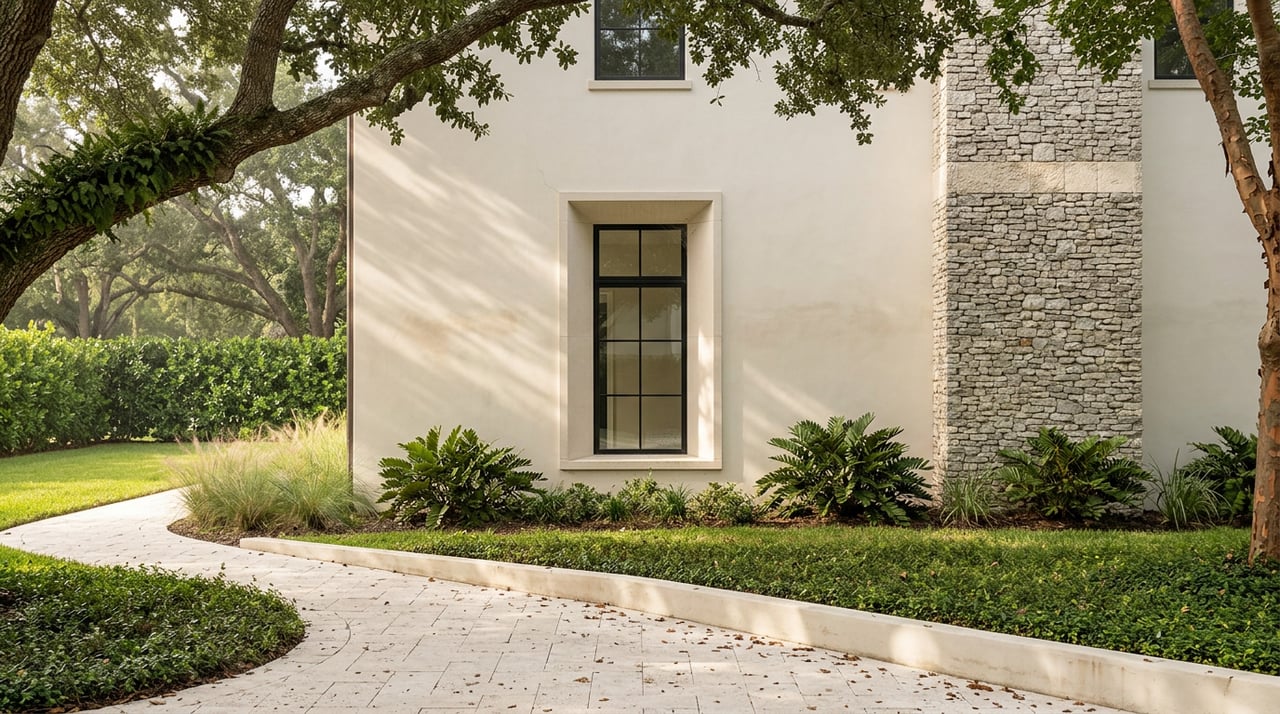
That is why the neighborhood reads as an enclave without a gate. The privacy comes from lot depth, mature canopy, and the absence of a design code telling a builder how far back the house has to sit.
The listings in 33143 do not distribute along a smooth curve. They cluster into three bands, and each band is a different bet on the underlying lot.
| Band | Recent asking examples | What the buyer is actually paying for |
|---|---|---|
| Entry, ~$2.9M–$3M | 5100 SW 75th Street (4 bed, 2,259 sf) | The lot and the ZIP. The house is a placeholder. |
| Renovated estate, ~$7M–$10M | 8010 Ponce De Leon Road (6,962 sf); 5002 SW 86th Street (5,908 sf); 8400 SW 52nd Avenue (6,495 sf) | Existing improvements you can live in for a decade before the market catches up. |
| Trophy new construction, ~$19M–$25M | 8755 SW 54th Avenue (12,152 sf); 5095 SW 82nd Street (10,693 sf); 4955 SW 83rd Street (9,952 sf) | A finished build on a premier lot at replacement cost, with no permit risk. |
The gap between the entry band and the trophy band is not a value judgment. It is an arbitrage. A buyer paying $2.9 million for a tear-down candidate is underwriting the same lot that will support an $18 million spec once it is scraped and rebuilt. The deals that pencil are the ones where the buyer knows which of the three bands they are actually shopping.
The MIAMI Association of Realtors® data for Q1 2026 recorded a 21% increase in luxury sales countywide with dollar volume up 15.6% year over year. In the same window the broader Miami-Dade single-family market ran 6.4 months of supply, 53 days from list to contract, and a 94% sale-to-list ratio. Those two facts do not describe the same market. They describe a split.
The county-wide 94% ratio tells you sellers with generic inventory are cutting price. The 21% luxury sales figure tells you well-located, supply-constrained inventory is not. Ponce Davis sits on the winning side of that split for the same reason it always has: roughly four blocks of estate-scale lots, no new supply coming online, and a buyer pool that has already ruled out the alternatives.
That is also why the mortgage-rate story matters less here than it does at the county median. As of mid-March 2026 the 30-year fixed averaged 6.11% per Freddie Mac's PMMS, down from 6.65% a year earlier, with MIAMI Realtors® projecting rates near 6.0% through 2026. In the $500,000 to $900,000 band, a 50-basis-point move brings sidelined buyers back. In the $8 million to $25 million band, the decision is capital structure, not payment sensitivity, and cash offers reset the underwriting entirely.
If the entry-band listings are the interesting ones for a developer or an owner-builder, the question is not what the lot costs. The question is what it costs to move the lot from raw dirt or tear-down to certificate of occupancy, and how long the county will hold your capital while it decides.
Under the current Miami-Dade RER Building Division process, a typical 33143 new build runs through the following sequence:
The realistic clock from clean submission to permit issuance is 6 to 12 weeks. That is faster than most out-of-state buyers expect, but it is not the timeline they were quoted by a builder friend in Palm Beach or Nashville. It is also HVHZ territory, which means every window, door, shutter, and roofing product must carry a Miami-Dade Notice of Acceptance. Substitutions late in the build are expensive.
For a buyer looking at 5100 SW 75th Street at $2.9 million with an eye toward a 7,000-square-foot replacement, the underwriting has to carry roughly a year of construction plus the permit runway before the pro forma turns. That is why the trophy comps look expensive on paper and reasonable on the spreadsheet.
The unincorporated status has one more consequence that only surfaces during a transaction.
Because Ponce Davis is county-permitted, any unpermitted work on a target property is a county lien question rather than a city code question, and the search runs through Miami-Dade RER records. Renovated estates in the middle band frequently carry legacy additions, screened patios, or pool cages that were built decades ago under different rules. Whether those exist "with permit" or "without permit" is a due-diligence line item that adds real cost when it is missed.
The same governance point cuts the other way for sellers. A homeowner in the city of Coral Gables who wants to build a taller house or a flatter roof is negotiating with a board. A homeowner in Ponce Davis is negotiating with the code, and the code is largely a wind-load and setback conversation. That is a real premium, and it is why long-tenured owners on Ponce De Leon Road, SW 82nd Street, and Davis Road do not move often. When they do, the transactions frequently close off-market.
Every published guide to this neighborhood mentions the lot sizes, the canopy, and the school proximity. Very few of them connect any of it to the folio number. The lots are large because there is no city zoning code compressing them. The architectural mix reads from Mediterranean to hard-edged contemporary because there is no municipal review board enforcing a single vocabulary. The tear-down math works because the permit path, while not trivial, is a predictable county process with a published fee schedule. The trophy prices hold because the supply of estate lots is fixed and the buyer pool has already narrowed itself to families that want to live in the house rather than lock and leave.
Everything the listing data shows in 33143 traces back to that one field on the property record.
Does Ponce Davis have any private roads, HOA, or gated sections? No. The neighborhood is non-gated at the community level. Individual estates commonly have their own gates and perimeter walls, but there is no association collecting dues, approving paint colors, or restricting rentals. Streets are public and maintained by Miami-Dade.
How does the October 1, 2025 fee change affect a typical Ponce Davis new build? Residential permit fees are calculated at roughly 0.5% of projected construction cost under the current schedule. On a $6 million build that is approximately $30,000 in building-permit fees before trade permits, impact fees, and plan review add-ons. It is a line item worth pricing early rather than at submittal.
Is the neighborhood inside a flood zone that changes the insurance math? Flood zone designations vary lot by lot inside 33143 and should be pulled from the current FEMA map for the specific parcel before an offer is written. This is one of the diligence items where a general neighborhood answer is not useful and the parcel-level answer is decisive.
Why do so many Ponce Davis sales close off-market? Turnover is low, buyer demand is concentrated, and sellers of estate-scale homes tend to prefer discretion. The result is that a meaningful share of the best inventory never reaches a public listing, which is where relationships and direct outreach carry the deal.
If you are underwriting a Ponce Davis purchase, a tear-down-and-rebuild pro forma, or a discreet sale of an estate that will not sit on the open market, Miami Brokers Group pairs brokerage with in-house financing through MBG Capital Partners so the lot, the build, and the capital stack are structured under one roof. Request a private valuation and consultation to walk the numbers on a specific parcel.
Stay up to date on the latest real estate trends.
Etiam non quam lacus suspendisse faucibus interdum. Orci ac auctor augue mauris augue neque. Bibendum at varius vel pharetra. Viverra orci sagittis eu volutpat.