Florida Keys Real Estate Market: Why Permits Matter More
August 20, 2026
August 20, 2026
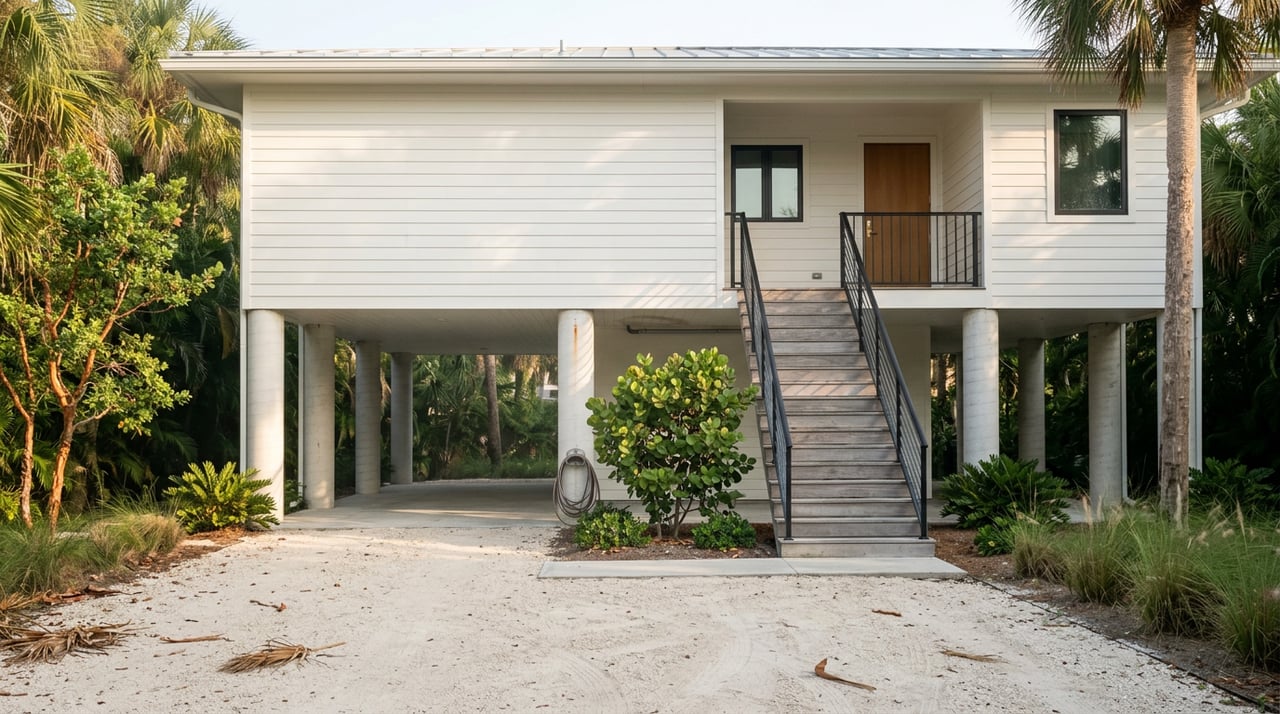
Picture two lots on the same canal in the Upper Keys. Same water depth, same distance to open water, same lot size. One has a small, dated 1970s stilt house on it, the kind an inspector would flag on sight. The other is bare, cleared, ready to build. Most buyers would assume the empty lot is the better deal: no demolition, no outdated bones to work around, a blank canvas for whatever they want to put there.
In the Florida Keys, that assumption is often backwards. The lot with the tired old house on it can be the safer purchase, and sometimes the more expensive one, because of something that has nothing to do with square footage or finishes. It has to do with which parcel is legally allowed to be rebuilt right now, and which one has to get in line.
Monroe County and its incorporated cities operate under a state-mandated cap on new residential construction, tied to a legal requirement that the Keys' full population be able to evacuate ahead of a hurricane within a set window. The mechanism that enforces this is the Rate of Growth Ordinance, known as ROGO in unincorporated Monroe County, with a parallel system called BPAS running independently in Key West, Marathon, and Islamorada. New construction on vacant land isn't a matter of pulling a permit and starting work. It's a competitive, points-scored application, and the number of allocations awarded each quarter is small by design. As of March 2024, unincorporated Monroe County had roughly 154 market-rate ROGO permits left to distribute before the current allocation pool runs out, with another 144 held in reserve for administrative relief. On Big Pine Key and No Name Key, home to federally protected species, the county awards an even smaller batch, closer to three allocations a quarter rather than the dozen typical elsewhere in the unincorporated county.
Here's the part that changes the math for buyers. A parcel that already had a legally permitted structure on it isn't subject to that queue at all. It's ROGO exempt. There's no deadline to start rebuilding, and no requirement to already hold a building right in hand. The owner only has to demonstrate that a previous structure existed on the lot. That's it. Tear the old house down, document what was there, and you can rebuild without ever entering the competitive scoring system that a vacant-lot buyer is stuck in.
| Vacant lot | Lot with an existing structure | |
|---|---|---|
| Path to a building permit | Competitive ROGO/BPAS application, scored quarterly | ROGO exempt, no application needed |
| Timeline to build | Depends on ranking and quarterly allocation size | No deadline, can start whenever |
| Depends on | State and county allocation decisions | Documentation of prior structure |
| What you're really financing | A chance at a future building right | A building right you already own |
Monroe County extended its current ROGO allocation window to run through July 2026, buying time while the state recalculated evacuation modeling. That window has effectively closed as of this summer. County planning staff, at a December 17, 2025 meeting where Governor Ron DeSantis and the Cabinet sat as the Administration Commission, recommended earmarking 62 of the county's remaining "administrative relief" allocations as a bridge to keep issuing permits through July 2027 while the state finalized guidance on a separate, larger release of new allocations.
That larger release comes from Senate Bill 180, which authorized up to 900 new permit allocations for the entire island chain, in exchange for the state agreeing to stretch the mandated hurricane evacuation clearance time from 24 hours to 24.5. Those 900 allocations aren't a lump-sum unlock. They're split among Monroe County and the Keys' incorporated municipalities based on how many vacant buildable lots each jurisdiction has, and they're set to be distributed over a period of at least ten years. County staff indicated in the fall of 2025 that Monroe County alone might eventually accept somewhere around 588 of those 900 rights, once the Florida Department of Commerce signs off on how they're distributed.
Translate that into buyer terms: if you're holding out for the vacant-lot market to loosen up once these new allocations arrive, the timeline runs in years, not months, and the allocations you'd be competing for are still scored the same competitive way the old ones were. None of that uncertainty touches a parcel that's already ROGO exempt. Its building right doesn't wait on Tallahassee.
The ROGO exemption isn't the only regulatory force acting on these properties, and the second one cuts against the first. Since 2022, flood insurance under the National Flood Insurance Program's Risk Rating 2.0 methodology prices premiums against the individual building, not just its flood zone designation. Elevation certificates, distance to water, and construction type now drive the number more than the AE or VE label on a flood map ever did.
That means an older, legally nonconforming home, built before 1975 at or near flood level, keeps its ROGO exemption and its right to rebuild, but it also carries a documented insurance penalty for sitting low. Meanwhile, new construction elevated several feet above base flood, which used to be the safe, cheap option, has seen quoted premiums climb to somewhere between $4,000 and $5,000 a year, well above the roughly $800 to $900 that similar elevated policies ran before the current pricing methodology took hold.
So the choice isn't between a clearly good option and a clearly bad one. It's a choice about which liability you'd rather manage: the multi-year uncertainty of a vacant lot waiting on a capped allocation system, or the insurance-cost uncertainty of a structure that's protected on the permit side but exposed on the premium side. One practical detail worth knowing before you close: flood insurance is the one policy type in a Keys transaction that can be assumed from the seller rather than rewritten from scratch, and assuming an existing policy is often cheaper than a new quote written under current Risk Rating 2.0 pricing.
Run this lens across the island chain and the price bands start to make more sense as something other than a simple distance-from-Miami gradient. Key West single-family homes typically run from roughly $1.1 million to $1.5 million. Marathon and Islamorada span a wider range, from about $800,000 up past $1.5 million. Key Largo sits lower, roughly $700,000 to $1.3 million, and the Lower Keys around Big Pine run from about $550,000 to $900,000. Part of what separates these bands is that Key West, Marathon, and Islamorada each run their own BPAS allocation system independent of the county's ROGO, meaning a buildable or ROGO/BPAS-exempt lot in one jurisdiction says nothing about availability in the next one over. For financing, Monroe County's conforming loan limit sits at $990,150 under its high-cost designation, a threshold worth knowing before you assume a purchase falls into conventional territory instead of jumbo.
Keys-wide sales data for the first quarter of 2026 showed transaction volume up 13.6 percent year over year, from 513 sales to 583, while the average sale price climbed 13.4 percent to $1,217,148. Total inventory across the same period fell by roughly 3 percent. In most markets, that combination, rising sales against shrinking supply, would eventually pull new listings onto the market until things rebalanced. In the Keys, that rebalancing lever barely exists. The supply of buildable, permit-eligible land isn't something sellers can decide to expand. It's capped by the same allocation math this whole piece has been about, which is a structural reason for the price trend, not a sentiment-driven one.
That's the piece of the story that gets left out of most guides to buying here. The headline number is the median price. The number that actually explains it is how many building rights are left in the queue, and who already owns one without knowing it.
For buyers weighing a vacant lot against an older home with a documented building history, or owners trying to price a property that's ROGO exempt correctly, that distinction is worth getting right before an offer goes in, not after. Miami Brokers Group pairs local transaction experience across the Keys with in-house financing through MBG Capital Partners, which matters here specifically because the insurance and permit questions above affect what a lender will underwrite. If you're weighing a Keys purchase or considering what your own parcel's building history is worth in this market, request a private valuation and consultation with Michael Diaz to get the specifics for your property.
Stay up to date on the latest real estate trends.
Etiam non quam lacus suspendisse faucibus interdum. Orci ac auctor augue mauris augue neque. Bibendum at varius vel pharetra. Viverra orci sagittis eu volutpat.